Most California homeowners finance their ADU rather than paying cash, and the loan you choose shapes the project's true cost. This calculator turns a construction budget, downpayment, interest rate, and loan term into the numbers that matter: your monthly payment, the total interest you'll pay over the life of the loan, and how quickly you build equity as the balance is paid down.
In this guide:
- How to Use This Calculator
- Understanding Your Results
- How the Monthly Payment Is Calculated
- Choosing an Interest Rate
- Downpayment & Loan Term
- Assumptions & Limitations
How to Use This Calculator
Enter four values and the calculator updates instantly. Every field accepts a range of realistic values, and out-of-range entries snap back to the nearest allowed value.
| Field | What to Enter |
|---|---|
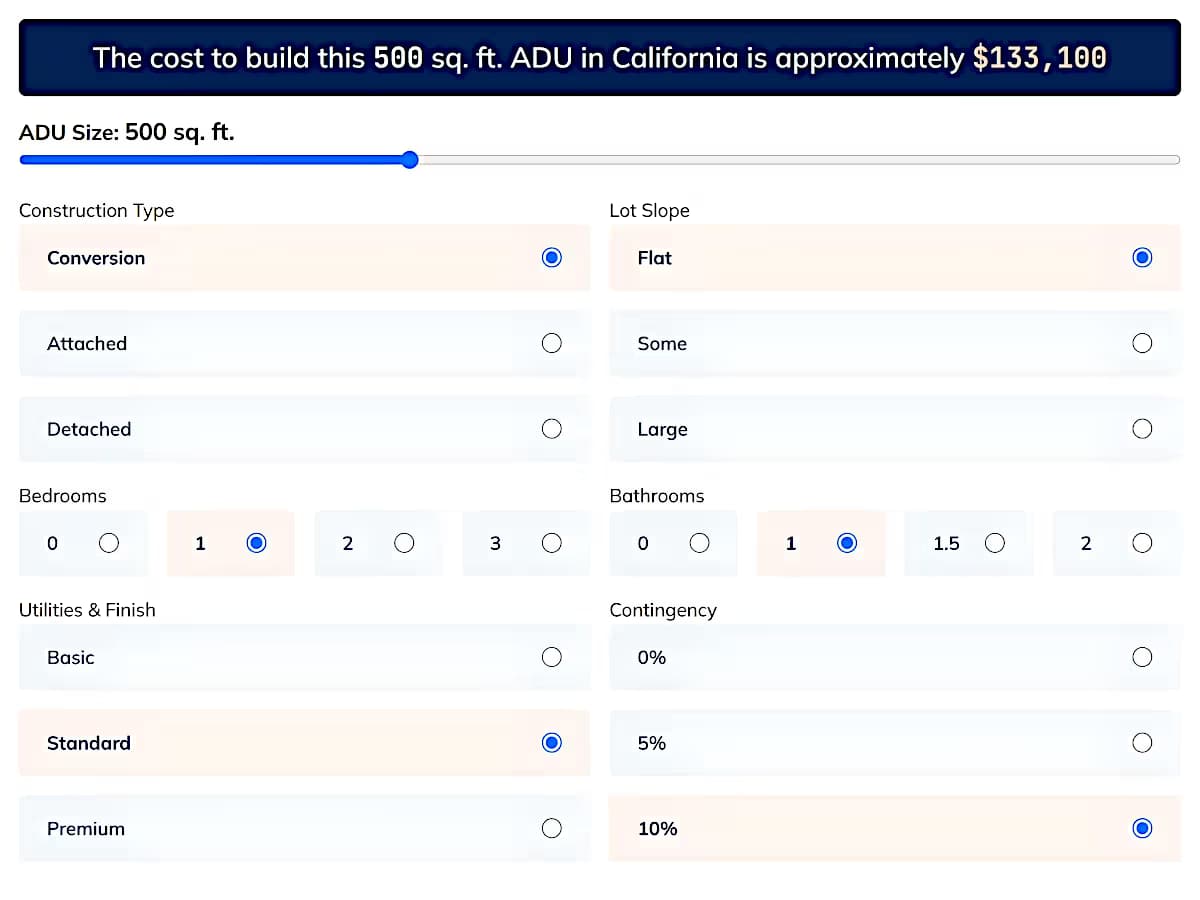
| Construction Cost | Your total project budget. If you don't have a contractor quote yet, estimate one with our Construction Cost Calculator. |
| Loan Downpayment | The percentage you pay out of pocket, and the remainder is financed. 20% is a common benchmark, but ADU loans vary — see below. |
| Annual Interest Rate | The yearly rate quoted by your lender. Use the rate for the specific product you're considering, not a generic mortgage rate. |
| Loan Term | How many years you'll take to repay, from 1 to 40. Longer terms lower the monthly payment but raise the total interest. |
Understanding Your Results
The Financing Details panel summarizes four figures:
- Loan Amount (construction cost minus downpayment)
- the fixed Monthly Payment
- the Total Interest paid over the full term
- the Total Payment (principal plus all interest)
Total interest is often the eye-opener — on a typical 30-year loan, it can approach or exceed the amount borrowed.
The chart plots two lines over the life of the loan. The Loan Balance line falls as you repay principal, while the Equity line rises by the same amount — they mirror each other and cross near the loan's midpoint by balance (typically well past the midpoint by time, since early payments are mostly interest). Hovering over any year shows both values.
The collapsible Amortization Schedule breaks every monthly payment into principal and interest, grouped by year, with running totals for interest paid and equity built. You can download the full schedule as a CSV for your own spreadsheet.
How the Monthly Payment Is Calculated
The calculator uses the standard amortization formula that virtually all fixed-rate loans follow: the annual rate is divided by 12 to obtain the monthly rate, and the payment is set so that, after the final month, the balance reaches exactly zero. Each month, interest is charged on the remaining balance first, and whatever is left of your payment reduces the principal.
That structure explains a pattern you'll see in the schedule: early payments are mostly interest, because the balance is still large. As the balance shrinks, an ever-greater share of the same fixed payment goes to principal, which is why the equity curve in the chart starts shallow and steepens over time.
Choosing an Interest Rate
The default of 6.5% reflects the general neighborhood of recent fixed home-lending rates, but the right number depends heavily on how you borrow. Common ways California homeowners finance an ADU include:
- Cash-out refinance — replaces your existing mortgage with a larger one; rates track standard 30-year mortgage rates.
- Home equity loan — a fixed-rate second mortgage against your existing equity; rates typically run somewhat above first-mortgage rates.
- HELOC — a variable-rate credit line; flexible during construction, but the rate can move with the market.
- Renovation / construction loan — underwritten on the property's future value including the ADU, useful when existing equity is limited.
Because this calculator models a fixed rate for the whole term, it maps most directly to a cash-out refinance or home equity loan. For a variable-rate HELOC, treat the result as a snapshot at today's rate.
Downpayment & Loan Term
The 20% downpayment default mirrors the traditional mortgage convention, but equity-based ADU financing often works differently — your home's existing equity effectively serves as the "downpayment", and some homeowners finance close to 100% of construction. Set this field to whatever share you actually plan to pay in cash.
Term length is the biggest lever on the monthly payment. As a rule of thumb, at mid-single-digit rates, moving from a 15-year to a 30-year term cuts the monthly payment by roughly a third, while roughly doubling the total interest paid. Try a few terms in the calculator and watch how Total Interest responds; the trade-off is rarely intuitive until you see the numbers.
Assumptions & Limitations
The calculator assumes a fixed interest rate, equal monthly payments, and no extra principal payments. It does not model closing costs, points, private mortgage insurance, variable-rate adjustments, or tax effects (interest on loans used to substantially improve your home may be deductible — ask a tax professional). Actual loan terms depend on your credit, income, and lender.
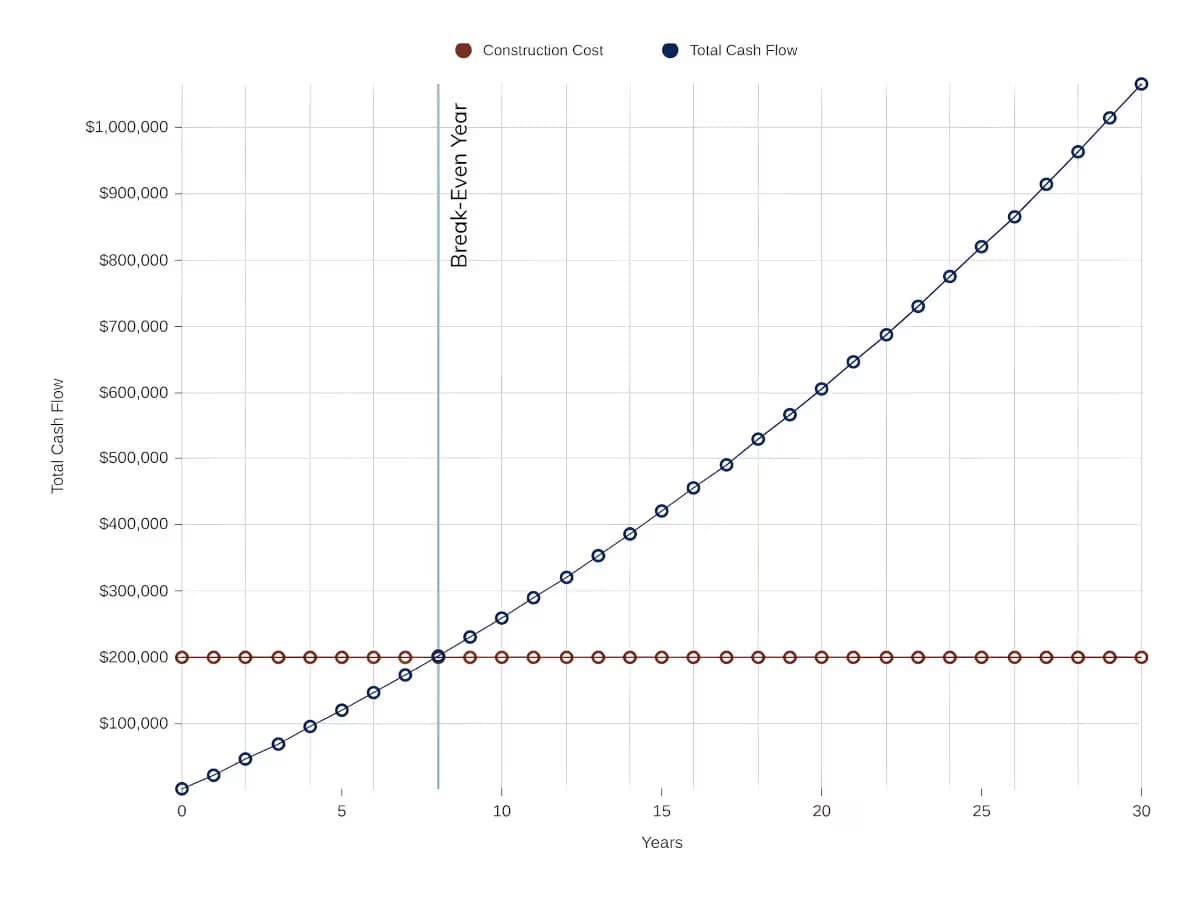
To see how loan payments interact with rental income from the ADU, pair this tool with the Cash Flow & ROI Calculator.