Building an ADU raises your property taxes — but far less than most homeowners fear. Thanks to Proposition 13, adding an ADU does not trigger a reassessment of your existing home: only the new construction's value is added to your tax bill. This calculator shows exactly what that added tax would look like over 30 years, using Prop 13's actual rules.
In this guide:
- How to Use This Calculator
- Understanding Your Results
- How Prop 13 Works
- Where the 1.1% Tax Rate Comes From
- Assumptions & Limitations
How to Use This Calculator
| Field | What to Enter |
|---|---|
| Current Assessed Value | The assessed value from your latest property tax bill — not your home's market value. If you've owned for years, Prop 13 has likely kept this far below market; using market value here would badly overstate your taxes. |
| ADU Construction Cost / Added Assessed Value | What the assessor will add for the new construction. Assessors typically value an ADU addition at or near its construction cost, so your project budget is the right starting point. |
| Assessed Value Growth Rate | Defaults to 2% — Prop 13's statutory annual cap. Use Custom only to model scenarios in which inflation runs below 2% (the cap is 2% or CPI, whichever is lower). |
| Property Tax Rate | Defaults to 1.1%, the California average effective rate. For precision, use Custom with your actual rate — divide your current tax bill by your assessed value, or find your Tax Rate Area on the bill. |
Understanding Your Results
The Property Tax Impact Analysis cards compare your annual tax bill Without ADU versus With ADU at 5, 10, 20, and 30 years — and, most usefully, the Added Annual Tax: the difference the ADU is responsible for. With the defaults ($500,000 assessed value, $200,000 ADU), the ADU adds roughly $2,200 in the first year, growing to about $4,000 by year 30 as the assessment compounds at 2%.
The chart plots both tax trajectories; they rise in parallel because the same 2% cap applies to both the existing assessment and the ADU's addition. The collapsible table breaks down assessed values and taxes year by year and is downloadable as CSV. A useful mental benchmark: the added monthly tax (about $180–200 initially with the defaults) is typically a small fraction of the rent an ADU generates.
How Prop 13 Works
Proposition 13, passed in 1978, sets three rules that shape California property tax bills:
- A 1% base tax rate on assessed value, statewide (local voter-approved additions raise the effective rate — see below).
- Assessed value grows at most 2% per year (or CPI, if lower), regardless of how fast market values climb. This is why longtime owners often pay taxes on a small fraction of their home's worth.
- Reassessment to market value happens only on a change of ownership or new construction.
Building an ADU falls under "new construction" — but crucially, the rule produces a blended assessment: the assessor values only the newly built ADU and adds it to your existing assessed value. Your home's original (often decades-old) assessment stays untouched, keeps its original base year, and both components then grow under the same 2% cap. The county assessor typically values the addition after completion, and you'll receive a supplemental tax bill for the partial year.
Where the 1.1% Tax Rate Comes From
Proposition 13's base rate is exactly 1%, but almost nobody pays exactly 1%. On top of the base, your bill includes voter-approved additions — school and infrastructure bonds, special districts, and direct assessments specific to your Tax Rate Area. Across California, these additions average roughly 0.1%, which is why 1.1% is the standard planning figure for the state's effective rate.
Actual rates vary by location — commonly between about 1.02% and 1.25% — depending on how many local bonds your area has passed. Your exact rate is listed on your tax bill; entering it via the Custom option ensures the projection is precise for your property.
Assumptions & Limitations
The model assumes a full 2% assessment increase each year (in low-inflation years, it can be lower), a constant tax rate (local bond measures can nudge it up or down over time), and that the assessor values the ADU at the amount you entered. It does not model Prop 8 decline-in-value reductions, exemptions (such as the homeowner's exemption), parcel taxes levied per unit, or reassessments that occur when a property changes hands.
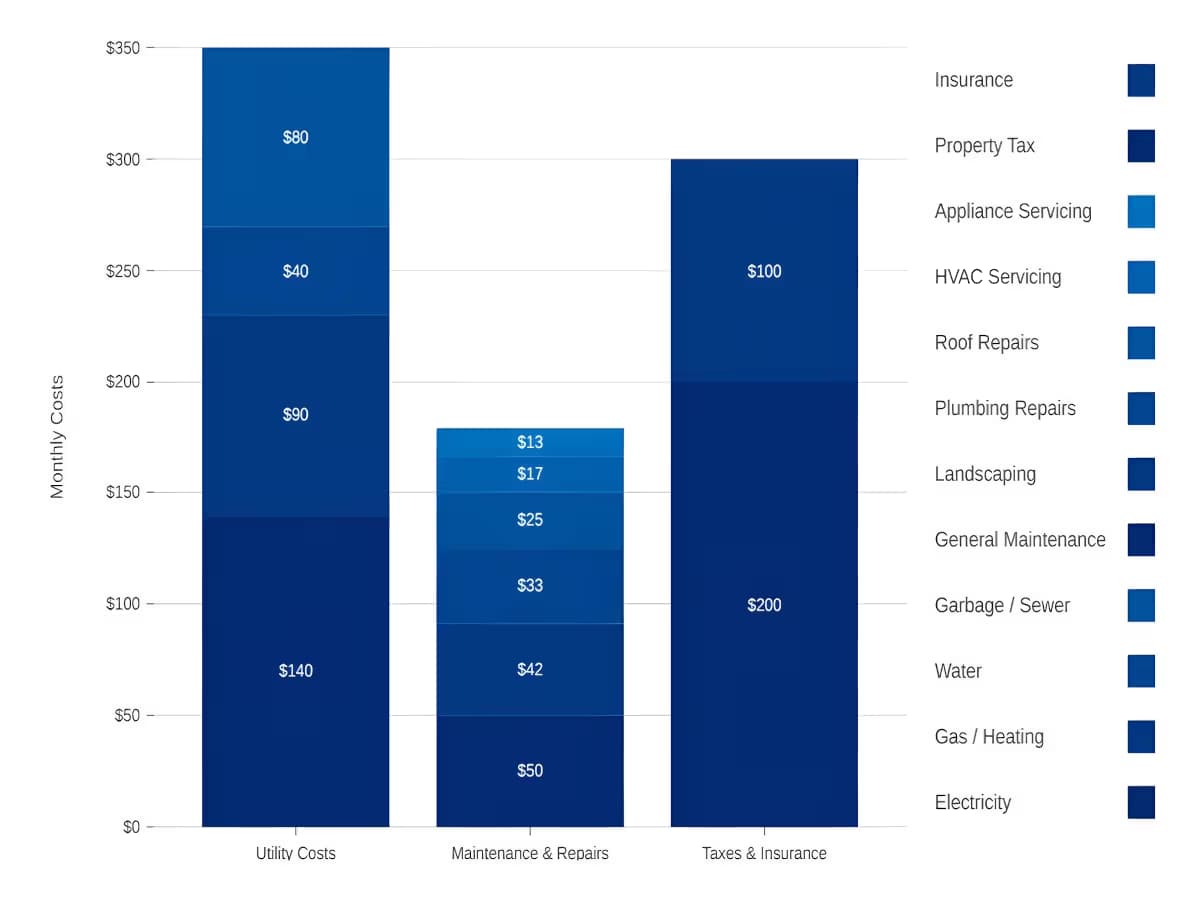
The added tax is one of the recurring ownership costs of an ADU — alongside utilities, maintenance, and insurance, which the Utility & Maintenance Cost Calculator covers. To see all costs weighed against rental income, use the Cash Flow & ROI Calculator.