Owning an ADU typically costs several hundred dollars a month beyond construction itself — utilities, upkeep, taxes, and insurance that continue for the life of the unit. This calculator itemizes those recurring costs so you can see a realistic monthly and annual budget before you build, and stress-test the rent you'd need to charge for the unit to carry itself.
In this guide:
- How to Use This Calculator
- Understanding Your Results
- Where the Utility Defaults Come From
- Maintenance: the 1% Rule, Itemized
- Taxes & Insurance
- Assumptions & Limitations
How to Use This Calculator
The form is split into three groups, and it's important to notice the period label on each: Utility Costs are monthly amounts, while Maintenance & Repairs and Taxes & Insurance are annual amounts. The calculator converts everything to a common basis for you.
- Utility Costs (monthly) — electricity, gas/heating, water, and garbage/sewer for the ADU. Enter what the unit itself will consume; if it shares meters with your main house, estimate its share.
- Maintenance & Repairs (annual) — six categories from general upkeep to appliance servicing. These are yearly budget figures, not bills you'll pay every year — a roof repair may be zero for five years and then significant.
- Taxes & Insurance (annual) — the ADU's added property tax and the increase to your insurance premium (not your whole-property totals).
Understanding Your Results
The Expense Cost Analysis table shows each category's monthly and annual totals side by side, with a total at the bottom — with the defaults, about $825 per month or $9,900 per year. The stacked bar chart below it breaks the same numbers down by individual line item, so you can see at a glance which costs dominate (utilities usually do, followed by taxes and insurance).
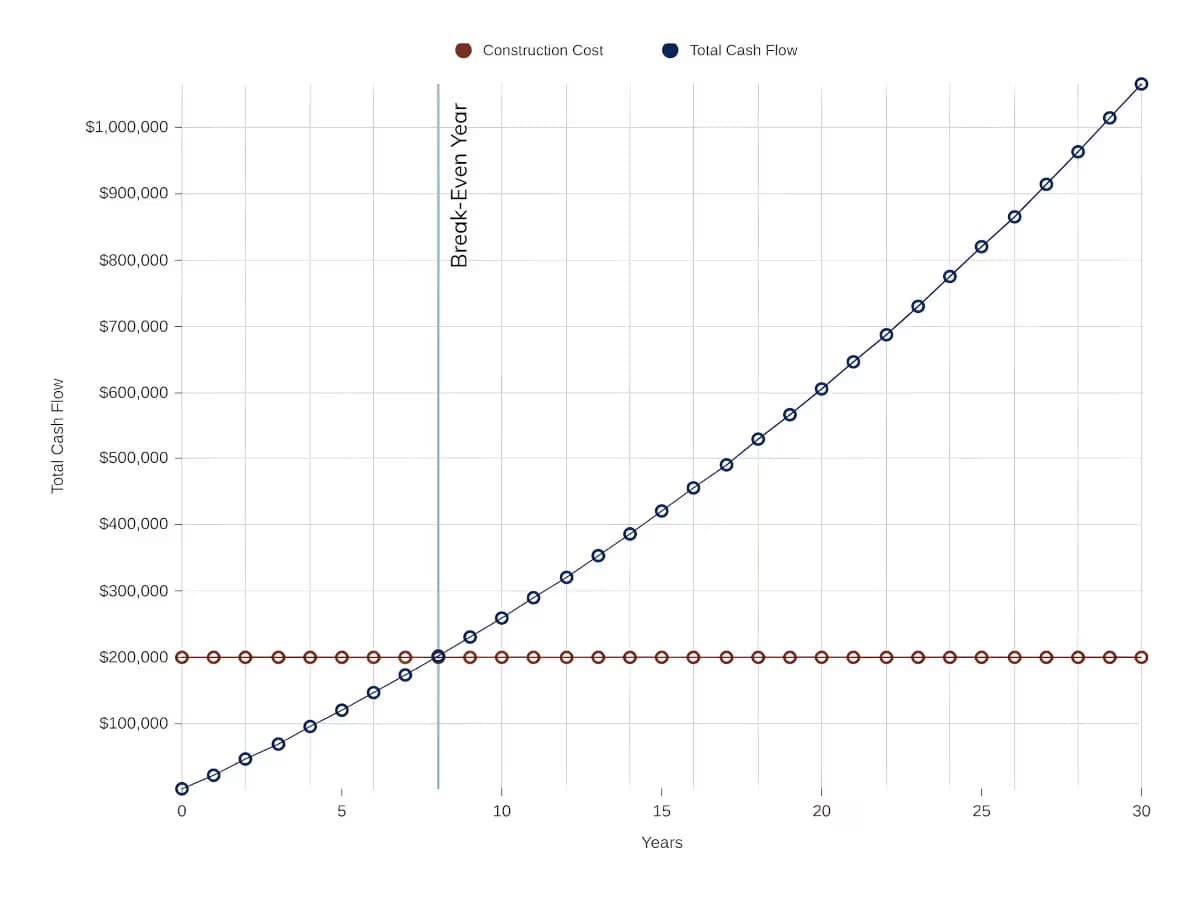
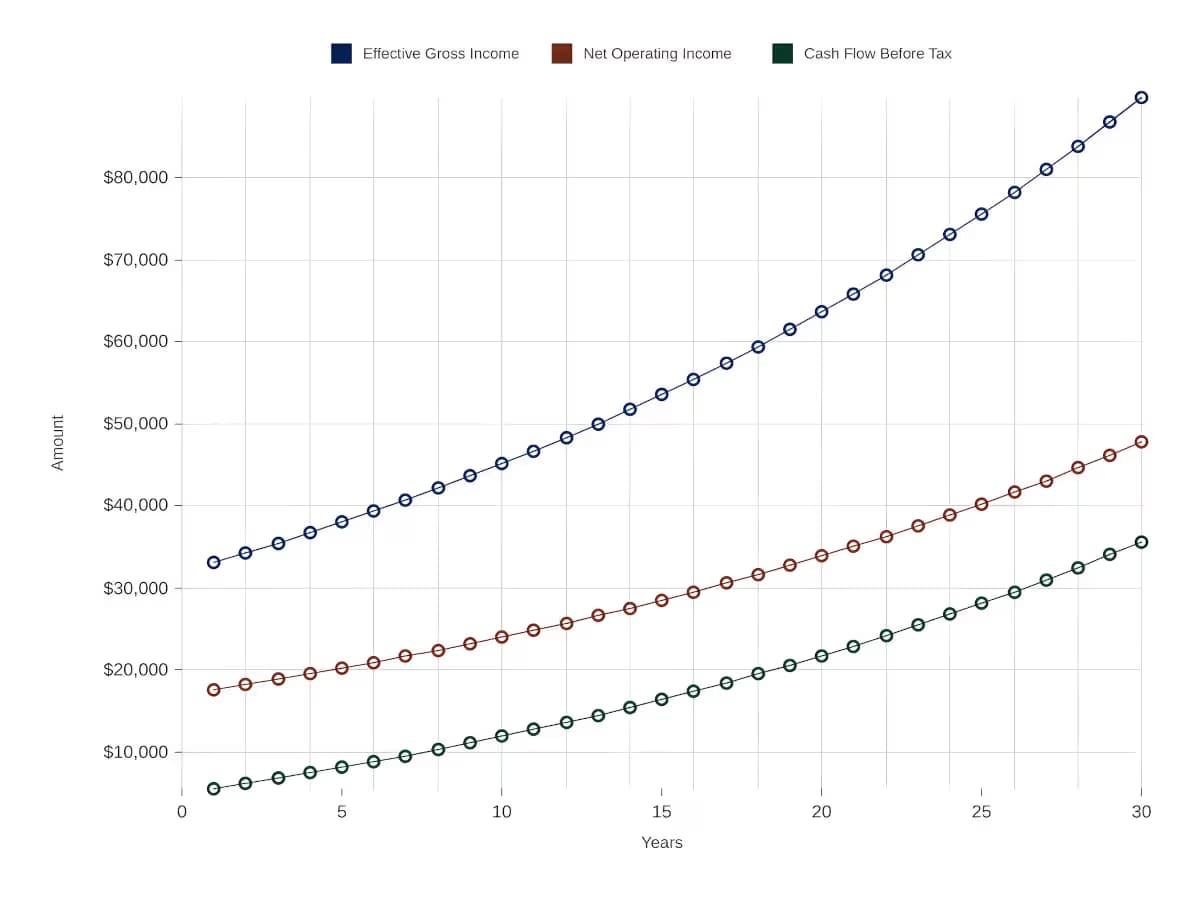
A useful way to read the total: it's the floor your monthly rent must clear before the ADU contributes anything toward recouping construction costs. Feed the annual figure into the Cash Flow & ROI Calculator as the "Utilities & Maintenance" expense to complete the picture.
Where the Utility Defaults Come From
The defaults model a typical small California ADU (roughly 500–800 sq. ft.) with one or two occupants:
| Utility | Default | Context |
|---|---|---|
| Electricity | $140 / mo | California's residential electricity rates are among the highest in the nation; a small, efficient unit with electric appliances costs $100–180 per month. |
| Gas / Heating | $90 / mo | Seasonal average — winter heating months run higher, summer lower. All-electric ADUs (increasingly common under modern energy codes) can shift this cost into the electric bill. |
| Water | $40 / mo | A one/two-person household's incremental usage. Irrigation for new landscaping can push this higher. |
| Garbage / Sewer | $80 / mo | Many cities charge sewer and refuse per dwelling unit, so an ADU often adds a full second charge rather than a marginal one. |
Whether these are your costs or your tenant's depends on the lease: with shared meters, most ADU landlords include utilities in the rent (and should budget them here); with separate meters, tenants commonly pay their own, and you can zero these fields out.
Maintenance: the 1% Rule, Itemized
A widely used rule of thumb is to budget about 1% of a dwelling's value per year for maintenance and repairs. For a $200,000 ADU, that suggests roughly $2,000 annually — close to the sum of the six default line items ($2,100). The itemization spreads that budget across the systems that actually generate the costs:
- General Maintenance ($600) — paint, caulking, filters, hardware, and the steady trickle of small fixes.
- Landscaping ($500) — upkeep of the yard area around the unit; set to zero for a garage conversion with no new landscape.
- Plumbing ($400) and Roofing ($300) — averaged reserves; new construction should see little of either in the first years, which is a reason to keep reserving rather than skip it.
- HVAC ($200) and Appliances ($100) — annual servicing plus a reserve toward eventual replacement (a mini-split or water heater lasts roughly 10–15 years).
A brand-new ADU will underspend these numbers early and overspend them late; budgeting the average from day one smooths the ride.
Taxes & Insurance
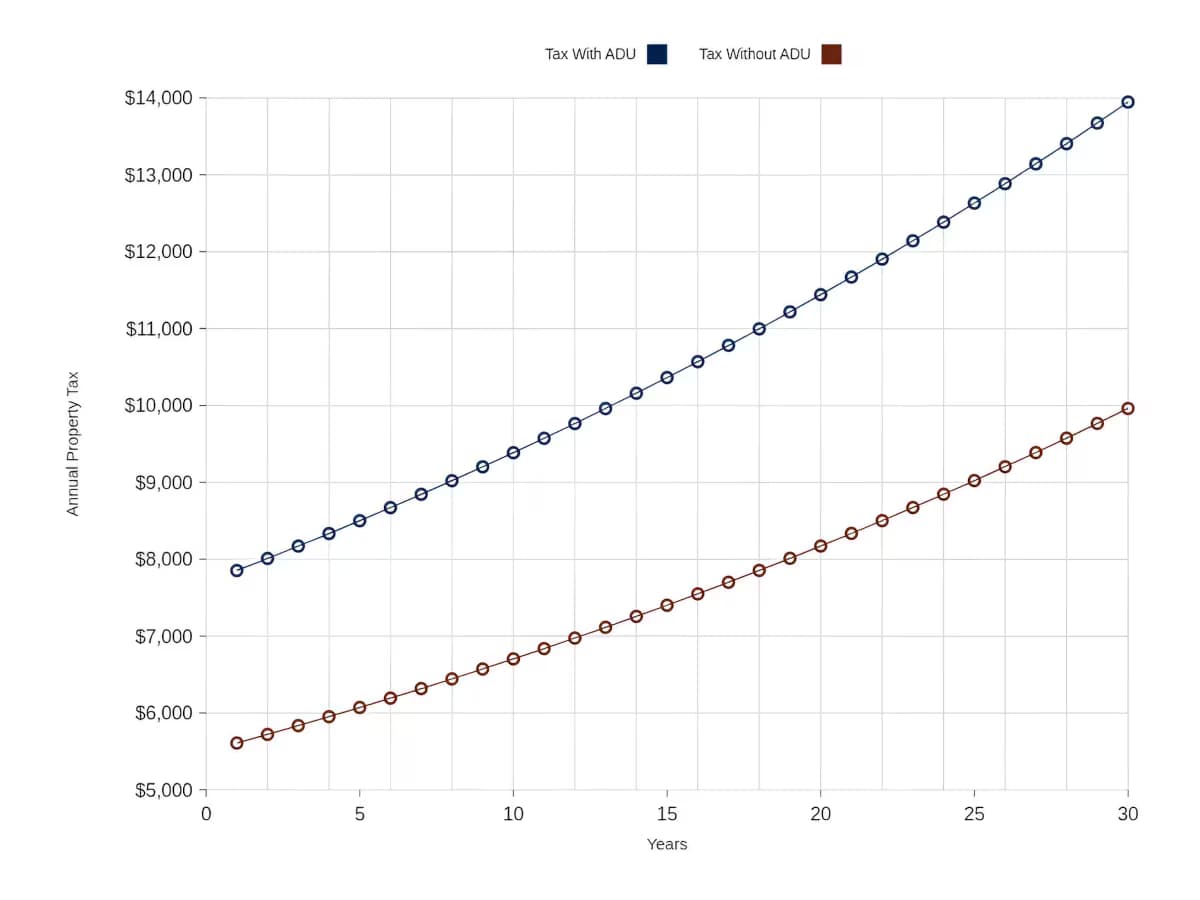
The $2,400 property tax default approximates the added tax on a typical ADU: California's effective rate averages about 1.1% (the 1% Prop 13 base plus local voter-approved assessments), so a $200,000–220,000 ADU addition adds roughly $2,200–2,400 per year. Importantly, building an ADU does not trigger reassessment of your existing home — only the new construction is added to your assessed value. Our Property Tax Reassessment Calculator models this in detail.
The $1,200 insurance default reflects the typical premium increase for adding a rental dwelling to a California homeowner's policy (or adding landlord/dwelling-fire coverage). Wildfire-zone properties can see substantially higher increases.
Assumptions & Limitations
All figures are in today's dollars, with no inflation applied — costs like utilities and insurance have historically risen by a few percent per year, so revisit the numbers periodically. The calculator also doesn't include property management fees, vacancy losses, or loan payments; those belong in the Cash Flow & ROI Calculator, which accepts this calculator's annual total as an input.